The biggest lie in baby clothing? That "soft" equals safe. Most of the fabrics marketed to parents today are petroleum-based plastics — and no amount of gentle-cycle washing changes that. Here's what's actually true, backed by research, and what you can stop worrying about.
---
Is "Baby-Safe" on the Label Enough?
No. The phrase "baby-safe" has no regulated definition in the United States. Any brand can print it on a tag without meeting a single verified safety standard. What actually matters is what the fabric is made of — not the marketing copy wrapped around it.
The American Academy of Pediatrics (AAP) has consistently flagged chemical exposure through skin contact as a concern in infants, whose skin absorbs substances at higher rates than adult skin. If the garment is made from polyester, "baby-safe" labeling doesn't neutralize the chemicals used in its production.
The phrase "baby-safe" has no regulated definition in the United States.
---
What Are the Most Common Baby Clothing Myths?
Myth #1: Soft Fabric Is Safe Fabric
Softness is a finish, not a material property. Microfiber, fleece, and brushed polyester can feel incredibly soft right out of the package — that texture is often the result of mechanical processing or chemical fabric softeners applied to plastic fibers.
True softness that holds up wash after wash comes from natural fiber structure. Peruvian Pima cotton has extra-long staple fibers that stay smooth without any additives. That's a structural fact, not a marketing claim.
Myth #2: Polyester Is Fine If It's Washed Before Use
Pre-washing reduces some surface residues, but it does not remove chemicals bonded into the fiber itself. Polyester is derived from polyethylene terephthalate (PET) — the same base material used in plastic bottles. Washing your plastic doesn't make it not plastic.
Research published in *Environmental Science & Technology* has found that synthetic textiles shed microplastics with every wash cycle. Those particles don't just go down the drain — they stay in the fabric long after the wash, and your baby's skin is in direct contact with them.
Myth #3: "Organic" Always Means Natural
Organic certification (GOTS, OEKO-TEX) verifies how a crop was grown and processed — it does not specify the base fiber. An organic polyester product is still polyester. An organic cotton product grown from lower-quality short-staple cotton still pills and irritates sensitive skin faster than long-staple varieties.
The fiber type and the farming practice are two separate questions. Both matter.
Myth #4: Babies Don't Need High-Quality Clothing — They Outgrow It Anyway
This one gets repeated constantly and it's the reasoning that puts the most babies in the most synthetic fabric. The logic assumes that because clothing is temporary, quality is irrelevant. But the first year of life is when skin barrier function is least developed. That's exactly when fabric quality matters most, not least.
The EWG (Environmental Working Group) has documented that babies are disproportionately vulnerable to chemical exposures precisely because their detoxification systems aren't fully developed. Cutting corners on fabric during this window isn't practical — it's a trade-off most parents don't realize they're making.
Myth #5: All Cotton Is the Same
Standard commodity cotton and Peruvian Pima cotton share a name and almost nothing else. Conventional cotton uses short staple fibers that break, pill, and scratch. Pima cotton — especially from Peru's Piura Valley — produces extra-long staple fibers that are naturally stronger, smoother, and more breathable.
The difference isn't branding. It's measurable at the fiber level. See the full breakdown at /pages/why-pima.
---

Does Flame Retardant Fabric Keep Babies Safer?
This is one of the most persistent myths in baby clothing, and it deserves a direct answer: not necessarily, and possibly at a cost.
U.S. flammability standards for children's sleepwear apply to items that are loose-fitting. Tight-fitting garments in natural fibers like cotton are exempt — and that exemption exists because snug-fit natural fiber clothing is considered an acceptable alternative to chemical flame retardant treatment.
The AAP and the EWG have both raised concerns about flame retardant chemicals in children's products. If you're buying sleepwear and the label says "flame resistant," ask how that resistance was achieved. Chemical treatment is not the only compliant option. Read the care and labeling guide at /pages/care-guide for what to look for.
---

Is Pima Cotton Worth the Price for Baby Clothes?
The honest answer is: it depends on what you're comparing.
A single Arubana piece costs more than a five-pack of polyester bodysuits. It also lasts longer, doesn't pill, doesn't degrade against skin, and doesn't shed microplastics into your baby's environment. If you buy fewer pieces made from better material, the per-wear cost often comes out comparable — and you're not putting plastic against your newborn's skin twelve hours a day.
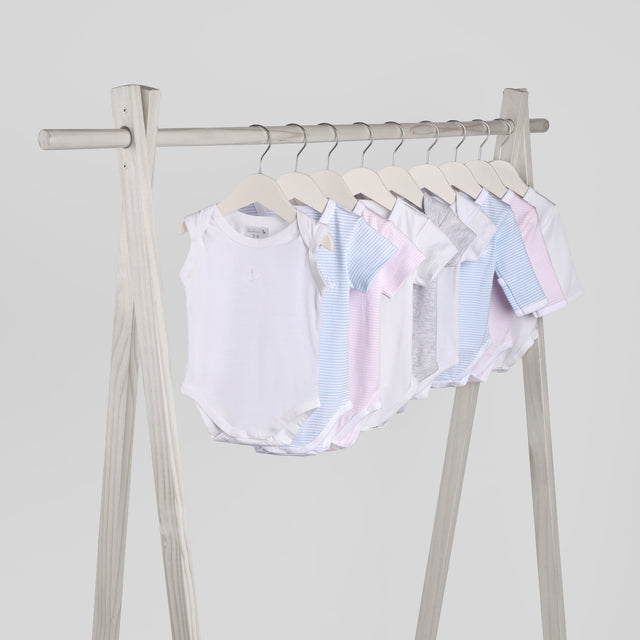
Arubana's small-batch collections are made from 100% Peruvian Pima cotton, produced in limited quantities so quality stays controlled. Featured in Vogue Latam alongside legacy fashion houses, not because of aesthetics alone — because the standard of material is that different.
---
FAQ: Baby Clothing Myths Debunked
Q: Is polyester dangerous for babies? Polyester is a plastic-based synthetic fabric. It doesn't breathe, it sheds microplastics, and it's produced using petrochemicals. While it isn't regulated as a toxin, the cumulative exposure concern — especially for newborns with developing skin — is real and documented by organizations like the EWG.
Q: What does OEKO-TEX certification actually mean? OEKO-TEX Standard 100 certifies that a finished textile has been tested for harmful substances and meets safety thresholds. It doesn't certify fiber type. An OEKO-TEX polyester garment is still polyester — just polyester that passed a chemical residue test.
Q: How do I know if a baby fabric is truly natural? Check the fiber content label, not the brand name or the marketing language. Look for 100% cotton, 100% Pima cotton, or 100% merino wool. Any percentage of polyester, nylon, spandex, or acrylic means synthetic content is present.
Q: Do natural fabrics shrink more than synthetic ones? Natural fibers like cotton can shrink if care instructions aren't followed, but quality long-staple Pima cotton shrinks minimally when washed in cold water and air dried. See the full care guide at /pages/care-guide.
Q: Aren't all baby brands required to meet safety standards? U.S. regulations cover flammability and some chemical limits, but they don't restrict synthetic fiber use or require disclosure of production chemicals. "Meeting standards" is a floor, not a guarantee of health-first design.
---
Stop Guessing. Start Reading Labels.
Every piece in Arubana's collection is 100% Peruvian Pima cotton — no blends, no synthetic filler, no exceptions. Small-batch production. Verified fiber. Made for parents who are done trusting packaging over material.