The best baby shower gift for health-conscious parents isn't a gadget, a subscription box, or another pastel onesie made from petroleum. It's clothing that won't leach synthetic chemicals against a newborn's skin for 12 hours a day. 100% Peruvian Pima cotton is that gift — and here's what every thoughtful buyer needs to know before clicking "add to cart."
---
Why Do Health-Conscious Parents Care So Much About Baby Fabric?
Because babies wear clothes constantly, against skin that absorbs differently than adult skin. The American Academy of Pediatrics (AAP) has explicitly flagged synthetic chemicals in children's products as a pediatric concern, noting that children are more vulnerable to environmental toxins due to their higher surface-area-to-body-weight ratio and developing organ systems.
When parents are researching at 2am, they're not being paranoid. They're doing math: if a newborn spends 16–18 hours a day in clothing, fabric choice is one of the highest-frequency exposures in a baby's life.
They're doing math: if a newborn spends 16–18 hours a day in clothing, fabric choice is one of the highest-frequency exposures in a baby's life.
What Makes Synthetic Fabrics a Problem for Babies?
Polyester — the dominant material in mass-market baby clothing — is plastic. It's derived from petroleum, and research published in environmental health journals has documented that synthetic textiles can shed microplastics and contain residual chemical processing agents including formaldehyde-based resins, phthalates, and azo dyes. The Environmental Working Group (EWG) maintains ongoing concern about synthetic fabric treatments and their skin-contact exposure potential in infants.
Health-conscious parents aren't avoiding polyester because it's unfashionable. They're avoiding it because the exposure profile for a newborn is genuinely different from an adult wearing a gym shirt for an hour.
---
What Is Peruvian Pima Cotton, and Why Does It Matter?
Pima cotton (Gossypium barbadense) is a naturally long-staple cotton variety. The Peruvian version — grown in the Piura and Ica valleys — is widely regarded as the finest cotton on Earth. The extra-long fibers produce a fabric that is:
- Softer than standard cotton at equivalent thread counts
- Stronger, meaning it holds its shape and doesn't pill or break down into microfibers the way shorter-staple cotton does
- Naturally hypoallergenic, with no synthetic finish required to achieve its characteristic softness
This matters for gift-giving specifically because 100% Peruvian Pima cotton clothing doesn't need marketing language to justify its price. The fiber does the work. When Vogue Latin America featured Arubana alongside heritage houses like Hermès and Louis Vuitton, it wasn't because of branding — it was recognition that the material standard itself places Arubana in a different category from fast-fashion baby basics.
---
Is All Cotton Baby Clothing the Same?
No, and this is a distinction worth understanding before you buy.
What's the Difference Between Pima Cotton and Regular Cotton?
Standard cotton uses short-staple fibers that create a rougher weave. It frequently requires additional fabric softeners, chemical finishes, or blending with synthetic fibers to feel soft against skin. That processing introduces the exact chemical exposure health-conscious parents are trying to avoid.
Pima cotton's long-staple fiber structure is inherently smooth. No chemical softening required. No synthetic blending needed. The softness is structural, not cosmetic.
What Should You Look for on a Baby Clothing Label?
The label should say exactly one thing about fiber content: 100% Pima cotton. Watch for:
- "Cotton blend" (usually contains polyester)
- "Soft cotton" without specifying staple length (likely standard short-staple)
- "Organic cotton" without origin or staple specification (organic certification addresses pesticides, not fiber quality)
Arubana's why Pima matters page breaks this down in detail if you want the full comparison before gifting.
---

What Makes Arubana the Right Choice for a Baby Shower Gift?
A few things converge that matter for gift-givers specifically.
Small batch production. Arubana makes clothing in small runs, USA-based, which means quality control isn't outsourced across a 10,000-unit production line. Each piece is traceable.
Single-material integrity. Every item is 100% Peruvian Pima cotton. There are no polyester liners, no spandex trim, no synthetic decorative elements that compromise the fabric's safety profile.
It's a gift that works on multiple levels. Health-conscious parents will immediately recognize what they're holding. Parents who haven't yet gone deep on fabric research will learn something meaningful from the gift itself.
For care guidance so the gift lasts, Arubana's care guide covers everything the recipient needs to know.
---

How Much Should You Spend on a Quality Baby Shower Gift?
The honest answer: enough to buy something that won't fall apart in three washes or require the parents to throw it out once they realize what's in it.
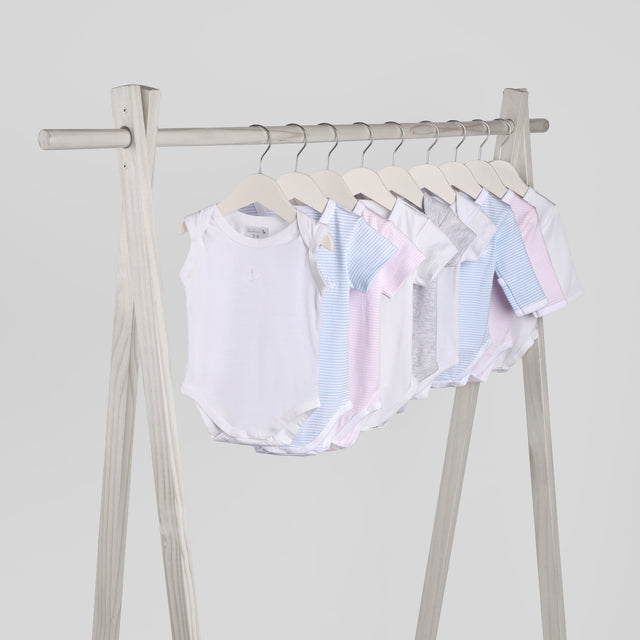
Health-conscious parents aren't impressed by price tags. They're impressed by material transparency. A small set of 100% Peruvian Pima cotton basics — a few bodysuits, a sleeper, a swaddle — in the $60–$120 range represents a genuinely useful, genuinely safe gift. More than that isn't necessary. Less than that often means corners were cut somewhere in the material chain.
Browse Arubana's full gift-ready selection at shoparubana.com/collections.
---
FAQ: Baby Shower Gifts for Health-Conscious Parents
Is Pima cotton better than organic cotton for babies? They address different concerns. Organic certification limits pesticide use in growing. Pima refers to fiber quality and length. The ideal is both: Peruvian Pima grown and processed without harmful chemical finishing, which is what Arubana delivers.
Can I gift Arubana clothing if I don't know the baby's size yet? Yes. Newborn sizing runs small and babies grow fast. A gift in the 3–6 month or 6–12 month range is almost always more useful than newborn sizes, which may only fit for a few weeks.
Is Pima cotton safe for babies with eczema or sensitive skin? Pima cotton is widely recommended by pediatric dermatologists for sensitive skin due to its natural softness and the absence of synthetic processing agents. Always confirm with the baby's pediatrician for clinical guidance.
What's the difference between Arubana and other "natural" baby brands? Most natural baby brands use standard organic cotton, which still uses short-staple fiber requiring additional softening. Arubana uses only 100% Peruvian Pima cotton — a structurally superior fiber that requires no chemical enhancement to be soft and durable.
How do I know the fabric is actually Pima cotton and not mislabeled? Origin matters. Genuine Peruvian Pima comes from a geographically specific growing region with established quality standards. You can read more at shoparubana.com/pages/why-pima.
---
Give the Gift That Doesn't Need to Be Returned
Health-conscious parents will know exactly what they have when they open it. Everyone else will figure it out after the first wash.
Shop Arubana's full collection at shoparubana.com/collections — small batch, 100% Peruvian Pima cotton, made for the parents who read the label.