Polyester is plastic spun into thread — and your newborn's skin is the most permeable it will ever be in their lifetime. No, polyester is not safe for newborn skin, and the reasons go well beyond rashes. Here's what the research says, and what actually belongs against your baby's body.
---
Why Does Newborn Skin React Differently Than Adult Skin?
A newborn's skin is not a smaller version of yours. It's structurally different in ways that matter when it comes to fabric choice.
Newborn skin is up to 30% thinner than adult skin, with a skin barrier — the stratum corneum — that hasn't fully matured. This means substances that touch your baby's skin don't just sit on the surface. They absorb. The American Academy of Pediatrics (AAP) has long flagged that newborns' higher surface-area-to-body-weight ratio makes them more vulnerable to topical exposures than older children or adults.
This is the baseline fact every fabric decision should start from: what touches your newborn's skin enters your newborn's body at a rate that should concern you.
---
What Is Polyester, Really?
Polyester is a synthetic polymer — polyethylene terephthalate (PET), the same class of plastic used in water bottles. It is manufactured through a chemical process that involves petrochemicals, and the resulting fiber retains chemical residues from that process, including antimony, a heavy metal catalyst used in PET production.
When you dress your newborn in a polyester onesie, you are wrapping them in plastic.
It is not a natural material. It does not breathe. It does not regulate temperature. And it does not belong next to skin that absorbs everything it contacts.
When you dress your newborn in a polyester onesie, you are wrapping them in plastic. That's not a metaphor. That's materials science.
---
What Are the Documented Risks of Polyester on Baby Skin?
Does Polyester Cause Skin Irritation in Newborns?
Yes — and frequently. Polyester fibers are rigid and non-absorbent, which creates two overlapping problems. First, the fabric traps heat and moisture against the skin, creating the warm, wet environment in which rashes, eczema flares, and contact dermatitis thrive. Second, the mechanical friction of synthetic fibers against immature skin causes microabrasions — tiny surface-level irritations that compromise barrier function further.
Research published in *Pediatric Dermatology* has linked synthetic fabric exposure to increased incidence of atopic dermatitis in infants with genetic predisposition. If eczema runs in your family, polyester isn't a risk worth taking.
Are the Chemicals in Polyester Baby Clothes a Concern?
The Environmental Working Group (EWG) has documented that synthetic textiles — including polyester — can contain residual chemicals from dyeing, finishing, and manufacturing processes: formaldehyde-releasing compounds, flame retardants, phthalates, and optical brighteners. Many of these are classified as potential endocrine disruptors.
Antimony — used as a catalyst in PET production — has been detected migrating from polyester fabrics in studies measuring dermal exposure. In adults, this is a low-level concern. In newborns with immature skin barriers and developing endocrine systems, the risk profile is meaningfully different.
Does Polyester Affect a Baby's Body Temperature?
Newborns cannot regulate their body temperature effectively. That's well-established neonatal physiology. Polyester actively works against thermoregulation: it traps heat, blocks airflow, and doesn't wick moisture. Overheating in infants is not a minor inconvenience — the AAP lists thermal environment as a factor in safe sleep guidelines precisely because overheating is a documented SIDS risk factor.
The fabric your baby sleeps in matters. Polyester makes thermoregulation harder. Natural fibers make it easier.
---

What Fabric Is Actually Safe for Newborn Skin?
Why Do Pediatric Dermatologists Recommend Natural Fibers?
Pediatric dermatologists consistently recommend natural, breathable fabrics for infants — particularly cotton — because natural fibers work with skin rather than against it. Cotton absorbs moisture, allows airflow, and doesn't carry the chemical residue load of synthetics. It's soft in a way that comes from its fiber structure, not a finishing treatment.
Not all cotton is equal, though. Standard commodity cotton is among the most heavily pesticide-treated crops in the world. Thread count and finish matter. What the cotton is treated with after harvest matters.
Why Is Peruvian Pima Cotton the Right Choice for Newborns?
Peruvian Pima cotton is a long-staple cotton variety grown in the Piura region of Peru. Its fiber length — averaging 1.5 to 2 inches — is what makes it genuinely different. Longer fibers mean fewer exposed ends per square inch of fabric, which translates directly to softness, durability, and less friction against skin.
Pima cotton is naturally hypoallergenic. It breathes. It regulates temperature passively. It absorbs moisture and releases it — which is exactly what you need against a newborn's skin.
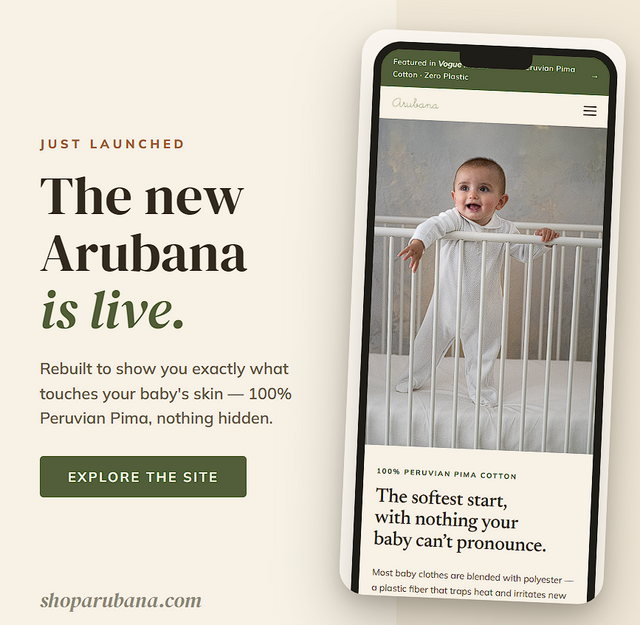
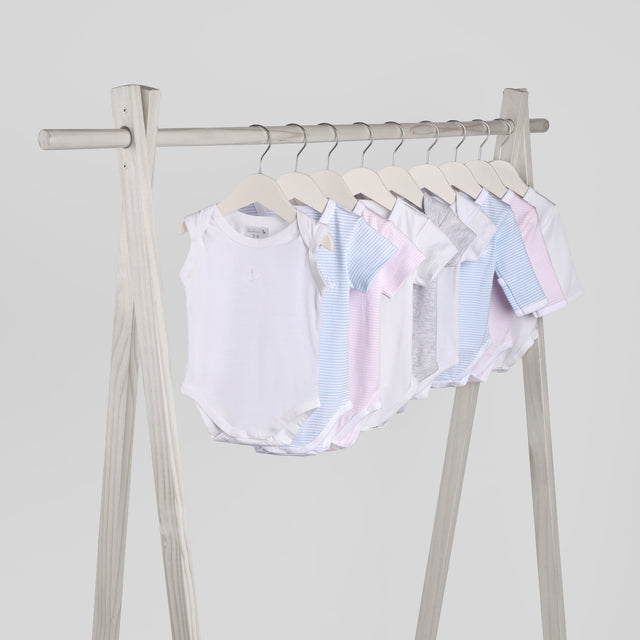
At Arubana, every piece is made from 100% Peruvian Pima cotton, small-batch, with no synthetic blends and no shortcuts. There is no polyester content at any percentage. That's not a marketing choice — it's a safety standard.
---

The 2am Bottom Line for Parents
If you're reading this because you're holding a onesie and wondering whether it's okay: check the label. If it says polyester — even 5%, even as a blend — put it down. Your newborn's skin will spend every hour of every day in contact with fabric. That contact is not neutral. It either supports healthy skin development or it works against it.
Natural. Breathable. Chemical-residue-free. Those are the criteria. Peruvian Pima cotton meets all three. Polyester meets none.
Browse Arubana's full newborn collection at shoparubana.com/collections — every piece is 100% Peruvian Pima cotton, free of synthetic blends.
---
FAQ: Is Polyester Safe for Newborn Skin?
Q: Is a small percentage of polyester in a blend okay for newborns? No percentage of polyester is ideal for newborn skin. Even low-percentage blends retain polyester's heat-trapping and moisture-blocking properties, and the chemical residue concern doesn't disappear with dilution. For newborns specifically, 100% natural fiber is the standard worth holding.
Q: What about "baby-safe" polyester or recycled polyester? "Baby-safe" is not a regulated claim. Recycled polyester (rPET) is still plastic — it retains the same fiber properties and similar chemical residue concerns. The recycling process does not make PET appropriate for sustained contact with newborn skin.
Q: How quickly can polyester cause a rash on a newborn? Reactions vary. Some newborns show contact irritation within hours; others develop chronic eczema or dermatitis over weeks of repeated exposure. Immature skin barriers mean the risk is highest in the first months of life.
Q: Can I wash polyester baby clothes to remove chemicals? Washing reduces surface residues but does not eliminate them. Studies on antimony migration from polyester fabrics show measurable transfer even after multiple washes. The safest approach is to avoid polyester in newborn clothing entirely.
Q: How do I care for Pima cotton baby clothes to make them last? See Arubana's full care guide for washing and storage guidance that preserves the softness and integrity of Pima cotton over time.
---
*Learn more: Why Pima Cotton · Arubana Blog · Full Collection*